

https://www.huffpost.com/entry/reverse-seasonal-affective-disorder-summer_l_6861f175e4b0a244c71334b0
Author: epash
Subtle Ways To Tell If Someone Is Good In Bed
https://www.bustle.com/articles/187110-subtle-signs-that-someone-is-good-in-bed
What Is the Dark Triad? 12 Signs to Know
https://www.purewow.com/wellness/dark-triad
Parents want to know they’re doing a good job. Can TikTok’s ‘toxic parenting’ challenge help?
https://www.yahoo.com/lifestyle/parents-want-to-know-theyre-doing-a-good-job-can-tiktoks-toxic-parenting-challenge-help-110039807.html?guccounter=1
Default Parent Divorce” Is On The Rise — & It’s A Lot More Than Chores
https://www.scarymommy.com/lifestyle/default-parent-divorce
Ellie Mental Health founder launches Pash Co. to incubate social health startups
https://www.bizjournals.com/twincities/inno/stories/news/2025/04/22/erin-pash-launches-social-health-incubator.html
A Toast to My Haters 🥂

My children recently shared a piece of wisdom that struck me deeply: when you start attracting haters, it means you’ve accomplished something significant enough to make many people proud while triggering strong emotional reactions in others. There’s profound truth in that observation.
Everyone’s Experience is Valid
I want to acknowledge something important: some of my critics have legitimate reasons for their feelings toward me. Perhaps I had to make the difficult decision to let them go from a position. Maybe I reported concerning behavior to a licensing board. In some cases, I denied a promotion or simply expressed an opinion they strongly disagreed with.
I have the courage to admit that I’ve made mistakes along my journey. I’ve hurt people in my pursuit of success, sometimes unknowingly and sometimes through necessary but painful decisions. For those hurts, I sincerely apologize. Growth requires accountability, and I own my missteps.
The Delusion of Distant Judgment
Then there are those critics who fall victim to their own naïveté. They express hostility, often publicly, because they’ve convinced themselves they understand everything about me—my decisions, my life, my motivations—when in reality, they couldn’t be further from the truth.
There’s something inherently delusional about harboring hatred for someone you’ve never even met. How can you possibly know the full context of another person’s choices? This realization has given me tremendous perspective about judging others and reinforced that powerful adage: “Everyone is fighting a battle you know nothing about, so just be kind.”
In our current culture, we’ve lost the benefit of the doubt. We’ve replaced curiosity with certainty, questions with accusations, and understanding with judgment.
Breaking the “Rise Above” Rule
A few months ago, I broke the cardinal rule of “never engage with haters” when I addressed some critics in a Facebook group. Everyone says, “Rise above, don’t interact.” But honestly? It was cathartic to correct misconceptions and introduce some truth into the conversation.
The most surprising outcome wasn’t the conflict that many predicted but transformation. What began as unprofessional criticism evolved into a thoughtful conversation about differing perspectives. Later, my inbox filled with messages of support—from silent cheerleaders and even from those who admitted they had transformed their jealousy of my success into inspiration for their own journey.
The Root of Hatred
I’ve come to understand that many haters simply haven’t evolved to a place of self-love where they can accept that not everything another person does is meant to harm them, even when it feels that way. Their reaction often reveals more about their wounds than my actions.
I often wonder: Why choose to troll the internet when you could channel that energy into creating positive change? Energy is finite. We all have the same 24 hours, the same limited emotional reserves.
Choosing a Different Path
I choose to use my energy to lift others up, to stay curious by asking questions about things I don’t understand, and to always—and I mean always—choose kindness.
This isn’t about being perfect. It’s about understanding that the path to growth is paved with both cheerleaders and critics. To my haters: thank you for the lessons. To my supporters: thank you for the love. And to everyone in between: I invite you to join me in choosing curiosity over judgment, conversation over condemnation, and kindness above all else.
Here’s my toast: to growth, to truth, and to the beautiful complexity of human connection—even when it’s uncomfortable.
Finding Wisdom in the Overwhelm: My Journey Through Life’s Chaos

I remember sitting on my kitchen floor last spring, feeling like I couldn’t take one more decision. One more problem. One more anything. The overwhelm wasn’t just emotional—I felt it in my body, like gravity had suddenly doubled its pull.
And then I stopped fighting it.
When I Learned to Slow Down
I’ve spent most of my life believing overwhelm was something to overcome, to push through with more organization, more effort, more grit. But that day on the kitchen floor taught me something different.
Instead of scrambling to my feet, I stayed there. I breathed. I let the tears come. I gave myself permission to feel completely overwhelmed by the beautiful chaos that had become my life—career pressures mounting, relationships straining, legal complications tangling with daily responsibilities.
That moment changed everything for me.
I’ve learned that when everything feels too much, the kindest thing I can do is to stop. To breathe deeply. To move through my hours one minute at a time if necessary. The world won’t fall apart if I pause—but I might fall apart if I don’t.
What My Overwhelm Was Trying to Tell Me
Looking back, I can see that my periods of greatest overwhelm weren’t random emotional storms—they were intensive courses in self-discovery.
When my career demands felt crushing and I questioned my path, my overwhelm was trying to tell me: “You need to redefine success on your own terms.”
When legal issues drained my energy and peace, my overwhelm was whispering: “This challenge is reshaping your resilience in ways you can’t yet see.”
When interpersonal conflicts left me exhausted and heartsick, my overwhelm was shouting: “Your boundaries need honoring—both by others and by you.”
I missed these messages for years because I was too busy trying to outrun the feeling.
A Gentle Reminder in the Middle of the Night
Maybe this perspective on overwhelm feels new to you. Or maybe, like me, you’ve heard it before but need constant reminders.
I still wake up sometimes at 3:30 AM, heart racing, mind spinning with all the uncertainties ahead. In those dark, quiet hours, overwhelm can feel suffocating. My old instinct is to fight against it—to make mental lists, to worry harder, as if worrying were a solution.
But then I remember: this feeling is a messenger, not an enemy.
I’ve learned to place a hand on my heart during those sleepless nights and whisper to myself: “You’re being prepared for transition. This discomfort is the feeling of growth. Don’t resist it—listen to it.”
Sometimes the most powerful thing I can do at 3:30 AM isn’t to force sleep or solve problems. It’s to accept that change is coming and that my overwhelm is trying to prepare me for it.
Finding My Path Forward
Now when overwhelm visits—and it still does—I approach it differently. I sit with it. I get curious about it.
I ask myself: “What’s trying to emerge in my life right now? What am I being asked to release? What wisdom awaits me on the other side of this feeling?”
Sometimes I journal these questions. Sometimes I take a long walk without my phone. Sometimes I just lie on the floor and breathe until the mental static quiets enough to hear what’s underneath.
One Breath at a Time
I no longer see my overwhelm as weakness. I see it as evidence of my evolution.
When life feels chaotic now, I remind myself: This discomfort is temporary, but the wisdom it offers could guide me for years. I take it one breath at a time. One hour at a time. One decision at a time.
The clarity I seek isn’t waiting somewhere beyond the overwhelm—it’s waiting within it, if I’m brave enough to stay present.
And I’m learning to be that brave, one overwhelming moment at a time.
Making Friends As An Adult Is Hard- A Licensed Therapist Shares How To Do It ( And Make It Last)
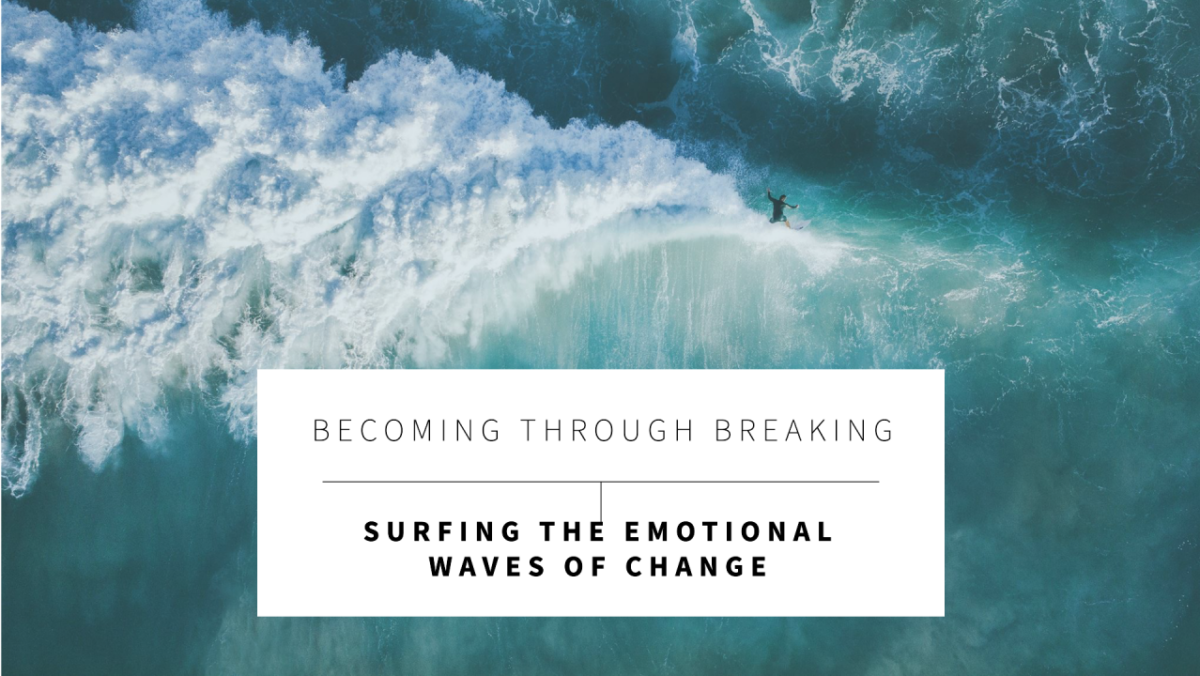
Becoming Through Breaking: Surfing the Emotional Waves of Change
I remember the exact moment I realized that this change wasn’t something that was happening to me, but rather through me. I was flying home with my family from a week in paradise. As soon as the picture perfect clouds became my view, as the jungle green faded below, and my Air Pods started playing that Brooks and Dunn remake, “Ain’t nothing bout you,” I knew it was game over. I tried to conceal my tears for the first 10 minutes but after a deafening blubbery snort startled my fellow passengers, it couldn’t be concealed any longer. I spent the rest of my 4 hour flight between hysterics and deep breaths knowing the coming week would be one of the hardest of my professional career. Tears streamed down my face – not delicate, cinematic tears, but the kind that come with full-body sobs that fog up your windows, which is surprisingly hard to do at 37,000 feet. In that moment, I felt every emotion possible: terror, excitement, grief, hope, all swirling together in a storm I couldn’t control.
Being an “expert” in human emotions, I understood what was happening in my brain during those intense moments, and knew that as much as I just wanted crawl in to my warm bed to sleep through the tears, my raging neurotransmitters experiencing intense emotional growth were in charge of my REM cycle, not me. Research from the University of California shows that during major transitions, our amygdala (the emotional center) and prefrontal cortex (our reasoning command center) are both highly activated. We’re literally in a “growth-optimal state,” even though it feels like torturous chaos. Knowing this helped me understand why I could feel simultaneously overwhelmed and incredibly clear-headed about what’s possible in my future and also why the anxiety and whirlwind of emotions has changed everything from my sleep to my digestion.

I’ve come to think of transitions as emotional surfing. Some days, I catch a wave of excitement that carries me so high I can hardly catch my breath – those moments when I’m buzzing with possibilities, when my future feels electric with potential. Other days, the wave crashes over me, and I find myself in the depths of doubt, wondering if this is all wrong and if I should beg for a way back to what I know. It’s dark and scary, and I worry I won’t make it back to the surface for air.
Research on emotional agility has helped me understand that both types of waves are essential. Learning about the importance of fully experiencing our emotions rather than suppressing them, I think about all the nights I spent journaling through my fears over the last 10 years and all the morning walks where I let myself dream wildly about what new idea I could bring to Ellie each day. Each tear and each smile was doing important work within me.
What I’ve discovered, in the raw and messy crucible of entrepreneurship, is that these soul-shaking feelings aren’t merely passengers on our journey of change – they’re the very engine of our transformation. The nights I’ve spent curled up on my bedroom floor, tears seeping into the carpet, my body wracked with sobs (and yes, that merciless flight-induced back pain), weren’t just moments of breakdown – they were moments of breakthrough. Each tear carried away not just emotion, but old limitations, worn-out beliefs, and the comfortable shell of who I used to be. Science tells us these moments of complete surrender actually strengthen our immune system and rebuild our psychological foundations, but what science can’t fully capture is how those hours on the floor – hours I wanted to dismiss as weakness – were actually my bravest moments. They were sacred investments in my evolution, even as every fiber of my being screamed to run back to the safety of who I was just a short time ago. Looking back, I realize those tear-stained moments weren’t just about letting go – they were about becoming.
Northeastern University’s, Dr. Lisa Feldman Barrett’s work on emotional granularity has taught me the importance of really naming and claiming what I’m feeling during transitions (clients too!). I’ve learned to distinguish between different types of fear – there’s the fluttery excitement-fear that comes with possibility, and there’s the heavy, stomach-dropping fear that might be trying to tell me to pause and reflect. Each emotion has its own intelligence, its own message to convey, and its imperative to let your brain and body figure out which is which in the messy process of transformation.
What fascinates me most about the gray matter folded inside our skull is neuroplasticity and how it validates what I’ve felt intuitively: these emotional extremes aren’t just experiences to endure – they’re actively rewiring my brain for greater resilience. Every time I push through uncertainty or allow myself to fully feel both my excitement and my terror, I’m not just changing my circumstances; I’m literally changing my brain’s capacity for handling future challenges. So all those tearful outbursts on my recent flight home, were essential to my growth journey (a sincere apology to my flight mates for the shrieking), despite the pain that pushed them to roll down my face.
No matter how many hours of therapy I’ve been in both as a client and therapist over the last decade, I can’t pretend that navigating transitions has gotten easier over the years. From losing some of my dearest friends to other opportunities or painstakingly necessary financial decisions, to saying goodbye to my business partner who was the first person to truly believe in me and my idea for Ellie, I’ve had my share of transitions in my role. Each new change brings its own flavor of challenge, its own emotional landscape to traverse. But I’ve learned to trust the process. When I find myself crying in parking lots (it seems almost daily), I remember that these tears are evidence of my growth, not a symbol of my weakness. When my heart races with anticipation about new possibilities, I let that energy fuel my next steps rather than trying to temper it with practicality.

Recent studies in the Journal of Personality and Social Psychology have shown that people who experience and process both positive and negative emotions during transitions show greater psychological growth. I see this truth reflected in my own journey. With each moment feeling there was the potential of a big transition on the horizon, it has left me not just with new and very real external circumstances, but with a deeper understanding of myself and a greater capacity for holding life’s complexities.
After walking this winding path of transformation, I find myself drawn – not just as a therapist, but as a fellow traveler through change – to reach out to those standing where I stand. If you’re in the midst of your own transition right now, know that I see you. I see you in all your beautiful chaos – whether you’re riding waves of hope so high they take your breath away, or feeling the undertow of doubt pulling at your feet. These feelings aren’t just normal; they’re the essential ingredients of your becoming. Your tears? They’re like spring rain, softening the hardened ground of who you’ve been, preparing the soil for who you’re becoming. Your excitement, even when it feels too big to hold, is the vital energy fueling your transformation. And those doubts that keep you awake at night? They’re not your enemies – they’re your wisdom asking the questions that will light your way forward.
I’ve learned that the power isn’t in reaching the destination – though that’s important too. The real magic lies in who we become as we navigate each emotional wave, each moment of uncertainty, each breakthrough. Trust me when I say that every intense feeling you’re experiencing is crafting something precious within you: a deeper trust in yourself, a more nuanced understanding of life, and an inner strength that can only be forged in the fires of transformation. And from someone who has surfed these waves more times than most 37 year old professionals should: the person you’ll become through this journey is worth every tear, every moment of uncertainty, and every surge of courage it takes to keep moving forward.
The research simply confirms what our hearts whisper in these moments of transformation: the magic isn’t in merely surviving the transition, but in allowing it to move through us like a wave, reshaping our internal landscape in ways we never imagined possible. As I sit here, my own heart cracked wide open by this earth-shattering moment of growth, I’m reminded of a profound truth: these moments of complete vulnerability – yes, even the ugly cries – are the powerful current, guiding us to the shore we were meant to find. Just as I stand now looking back at that tear-stained woman on the flight home, a version of you stands grateful – grateful for this moment when you had the courage to feel it all, when you let your tears fog up the windows at 37,000 feet. Like me, you’ll understand that every sob in your car, every middle-of-the-night journal entry, every moment you chose to stay when everything in you wanted to run – was the transformation doing its sacred work. This is how we grow, through the beautiful mess of it all. This is how we become, one powerful wave at a time. And this is how we learn to ride the currents of change – not by controlling the tide, but by trusting the ocean enough to just keep swimming. I know because I’m still surfing, still growing, still becoming. And somewhere between the depths and the surface, I’ve found that every wave is worth the ride.
